

On May 28, 2026, the ONTR token on Ethereum was drained of approximately $98,315 in a matter of minutes. The culprit wasn’t a complex cryptographic puzzle or an elaborate flash loan scheme - it was something far more ironic: the contract creator renounced ownership as a trust signal to the community, unknowingly activating a backdoor hidden in the onlyOwner modifier that let anyone reclaim ownership.
A single ownership renouncement - meant to say “nobody controls this contract” - became an open invitation for exploitation. Here’s how a trust-building gesture turned into a $98K catastrophe.
Date: May 28, 2026
Protocol: ONTR Token (Ethereum)
Loss: ~49.4801 WETH (~$98,315)
Root Cause: Flawed
onlyOwnermodifier treats renounced ownership (owner == address(0)) as a pass-all conditionVulnerable Contract:
0xf074865358b0dd039beee075831f8a2ae6b1f3f3(ONTR Token)Attacker:
0xe806B37A2caab7E65057A24E3802aDa757550b760Attack TX:
0x98f80eff0ce609606bb73cef3edfbb4c1d415ffc7676fec16f4d980c54903621
Background
ONTR is an ERC-20 token deployed on the Ethereum mainnet. Like many tokens in the DeFi ecosystem, it maintained a liquidity pool paired with WETH on a decentralized exchange (PancakeSwap). The contract implemented standard ownership patterns - or so it appeared.
At deployment in block 25192445 (May 28, 2026, 07:48:11 UTC), the contract creator did something common in the token space: they renounced ownership immediately. The on-chain logs tell the story clearly - two OwnershipTransferred events fired in the same deployment transaction:
OwnershipTransferred(address(0) → 0x1cFF...9718)- deployer receives ownershipOwnershipTransferred(0x1cFF...9718 → address(0))- deployer renounces ownership
In DeFi, renouncing ownership is typically a trust signal - it tells users “nobody can rug this contract.” But in the ONTR contract, this gesture had the exact opposite effect. The contract featured several owner-restricted functions, including obscurely named methods like desertJasper() and glenFlash(), which could manipulate token balances directly. These functions were gated by an onlyOwner modifier - and the modifier had a fatal flaw that turned renounced ownership into an open door.
Root Cause
The vulnerability lies in the custom Ownable contract (verified source on Etherscan) bundled with the ONTR token. Instead of using the standard OpenZeppelin Ownable, the contract rolled its own version with heavily obfuscated variable names - and a fatal flaw in the modifier:
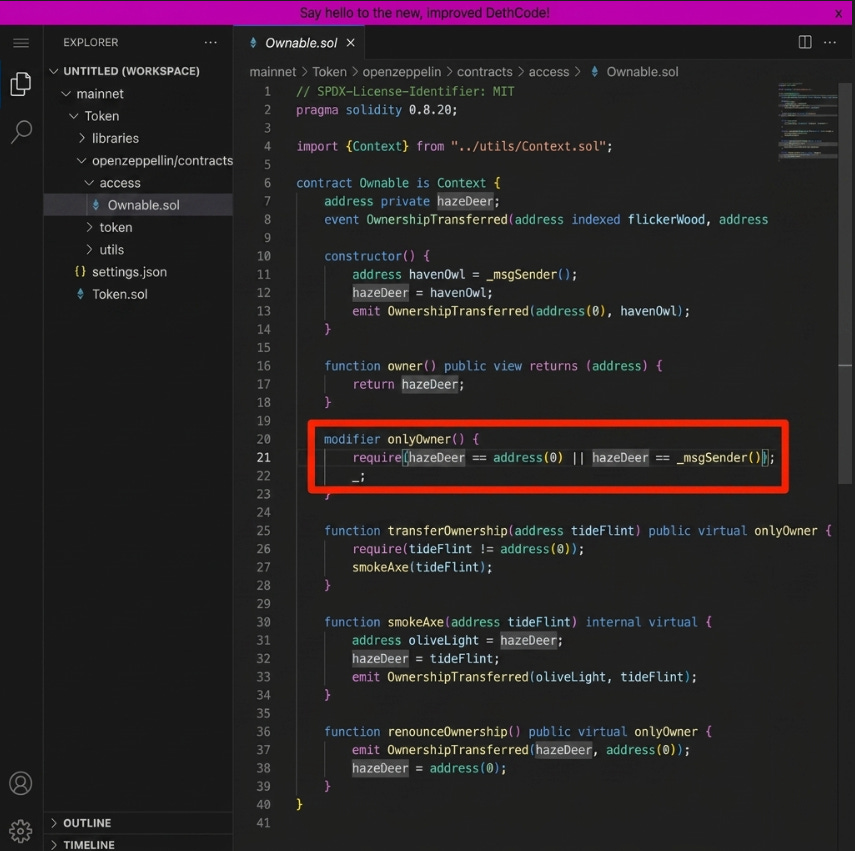
Here’s where it gets interesting. The require statement contains an OR condition: hazeDeer == address(0) || hazeDeer == _msgSender(). This means the check passes in two scenarios:
The caller is the owner - this is the intended behavior
The owner is the zero address - this is the vulnerability
The on-chain evidence is unambiguous: the contract creator deliberately renounced ownership to address(0) at deployment. This wasn’t a missing initialization - it was an intentional action. But combined with the flawed modifier, renouncing ownership didn’t lock out admin functions. It unlocked them for everyone.
The contrast with the real OpenZeppelin Ownable is stark:
// Secure: Real OpenZeppelin Ownable - renouncing LOCKS admin functions
modifier onlyOwner() {
    if (owner() != _msgSender()) {
        revert OwnableUnauthorizedAccount(_msgSender());
    }
    _;
}
// After renounceOwnership → owner = address(0) → address(0) != msg.sender → REVERTS
// Vulnerable: ONTR's custom Ownable - renouncing OPENS admin functions
modifier onlyOwner() {
    require(hazeDeer == address(0) || hazeDeer == _msgSender());
    _;
}
// After renounceOwnership → hazeDeer = address(0) → address(0) == address(0) → PASSES!
In the real OpenZeppelin Ownable, renouncing ownership sets owner to address(0), and since address(0) != msg.sender for any real caller, all admin functions become permanently locked. That’s the correct behavior. In ONTR’s custom version, the extra || hazeDeer == address(0) condition means renouncing ownership has the opposite effect - it makes admin functions callable by anyone. The obfuscated variable name hazeDeer instead of _owner is just icing on the cake - an attempt to make the code harder to audit.
Step-by-Step: The Attack
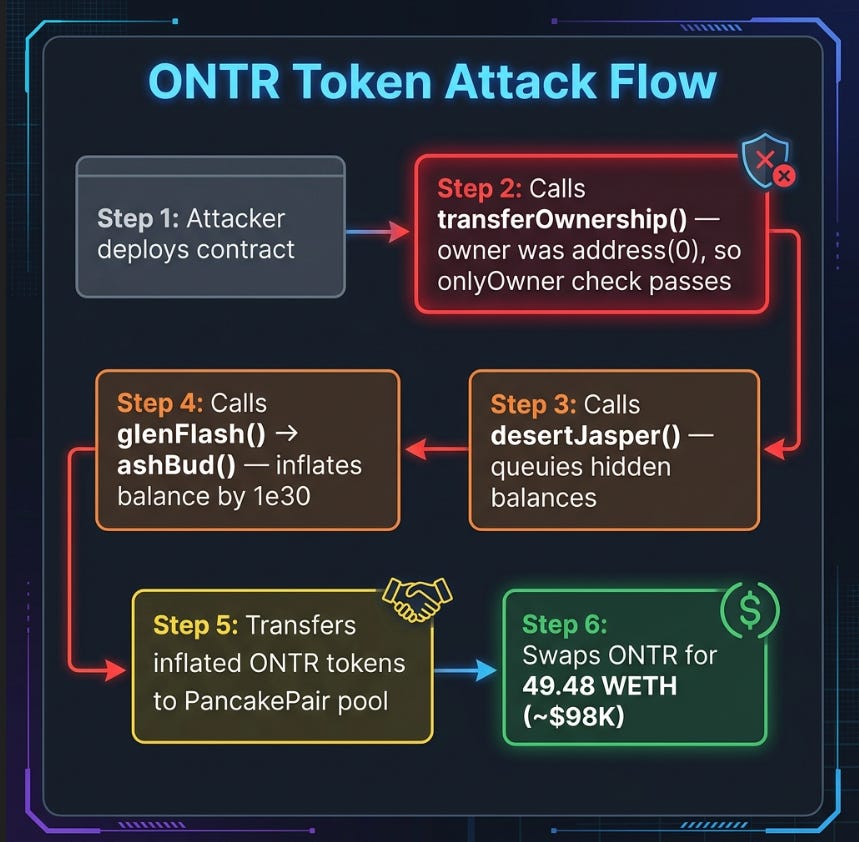
Deploy Attack Contract - The attacker at
0xe806...b760deployed a malicious contract approximately 2 hours after the ONTR token was created and ownership was renounced. They likely spotted the renouncement event and analyzed the modifier logic.Claim Ownership via
transferOwnership()- Since the creator had renounced ownership (owner == address(0)), theonlyOwnermodifier was trivially bypassed. The attacker calledtransferOwnership()to set their own contract as the new owner. No keys stolen, no social engineering - just calling a public function that the renouncement was supposed to have locked forever.Queue Hidden Balances via
desertJasper()- Now the legitimate owner, the attacker calleddesertJasper(), an obscurely-named function that writes arbitrary values into an internal_queuemapping. This function accepts arrays of target addresses and balance values, effectively staging the balance inflation.Execute Balance Inflation via
glenFlash()→ashBud()- The attacker then calledglenFlash(), which internally invokesashBud(). This function copies the queued values directly into_balances- without updatingtotalSupply. The attacker’s balance was inflated by 10^30 base units of ONTR tokens, all invisible to thetotalSupplyvariable.Transfer Inflated Tokens to Liquidity Pool - The attacker transferred the freshly minted (or rather, fabricated) ONTR tokens to the PancakePair liquidity pool contract that held the ONTR/WETH pair.
Swap for WETH and Profit - Finally, the attacker executed a swap against the liquidity pool, draining 49.4801 WETH (~$98,315) in exchange for the worthless inflated tokens.
The entire attack was executed in a single transaction, leaving no time for monitoring systems to react before the funds were gone.
Code Analysis
The exploit chain involved three key functions working in concert. Let’s examine each one:
The Gateway: transferOwnership()
From the actual ONTR source (Ownable.sol):
function transferOwnership(address tideFlint) public virtual onlyOwner {
    require(tideFlint != address(0));
    smokeAxe(tideFlint);
}

function smokeAxe(address tideFlint) internal virtual {
    address oliveLight = hazeDeer;
    hazeDeer = tideFlint;
    emit OwnershipTransferred(oliveLight, tideFlint);
}
This function should have been permanently locked after the creator renounced ownership. But with hazeDeer == address(0) and the flawed modifier treating that as a pass-all condition, the attacker simply called it with their own contract address - instant ownership of a contract that was supposed to be “ownerless.”
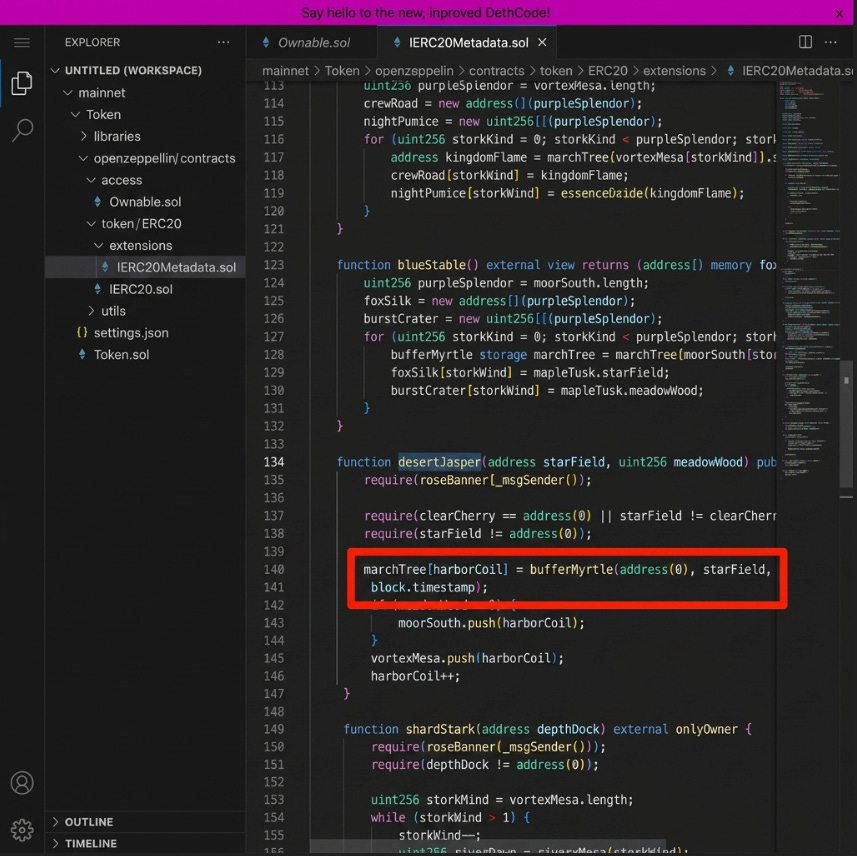
The Staging: desertJasper()
From the actual ONTR source (IERC20Metadata.sol):
function desertJasper(address starField, uint256 meadowWood) public onlyOwner {
    require(roseBanner(_msgSender()));
    require(clearCherry == address(0) || starField != clearCherry);
    require(starField != address(0));

    marchTree[harborCoil] = bufferMyrtle(address(0), starField, meadowWood, block.timestamp);
    if (meadowWood > 0) {
        moorSouth.push(harborCoil); // Stages balance inflation entries
    }
    vortexMesa.push(harborCoil);
    harborCoil++;
}
This function writes to internal mappings using completely obfuscated names - marchTree, harborCoil, bufferMyrtle, moorSouth, vortexMesa. But strip away the wordplay and the logic is clear: it queues a target address (starField) with a balance value (meadowWood) for later execution. The moorSouth array acts as a queue of pending balance inflations.
The Trigger: glenFlash() → ashBud()
function glenFlash() external { // NOTE: No onlyOwner modifier!
    uint256 sandFern = moorSouth.length;

    for (uint256 storkWind = 0; storkWind < sandFern; storkWind++) {
        uint256 riverDawn = moorSouth[storkWind];
        bufferMyrtle storage mapleTusk = marchTree[riverDawn];

        ashBud(mapleTusk.starField, mapleTusk.meadowWood); // Inflates balance
    }

    delete moorSouth;
}
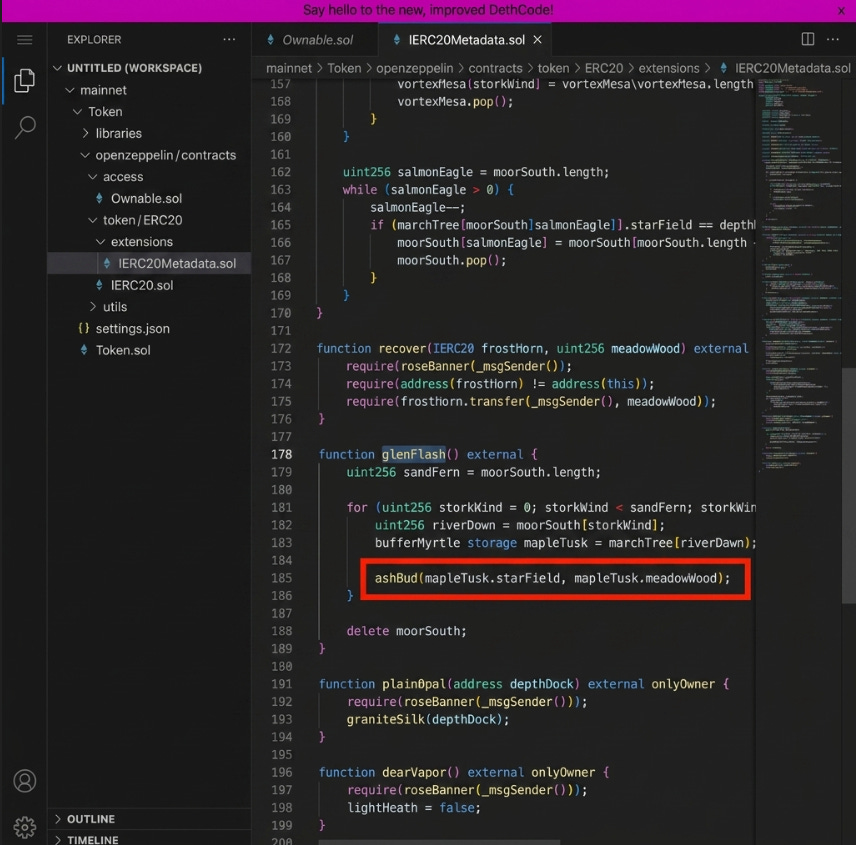
Notice a critical detail: glenFlash() has no onlyOwner modifier - it’s callable by anyone. It iterates through the moorSouth queue and calls ashBud() for each entry, which directly overwrites _balances without updating totalSupply. This means:
The inflated tokens appear in the balance mapping but the total supply remains unchanged
Standard monitoring tools checking
totalSupplyanomalies would see nothing wrongThe ERC-20 interface reports the attacker’s balance as valid, so DEX swaps execute normally
This is a textbook example of shadow minting - creating tokens that exist only in the balance mapping, invisible to supply-tracking mechanisms but fully functional for transfers and swaps.
Lessons Learned
Never use
address(0)as a bypass condition in access control. TheonlyOwnermodifier should never includeowner == address(0)as a passing condition. Renouncing ownership toaddress(0)is meant to permanently lock admin functions - not open them to everyone. Use OpenZeppelin’sOwnablewhererenounceOwnership()makes allonlyOwnerfunctions unreachable.Understand the interaction between renouncement and custom modifiers. The ONTR creator likely believed renouncing ownership would make the contract immutable. Instead, the custom modifier logic turned renouncement into an open backdoor. If rolling custom access control, test every edge case - especially the
address(0)owner state.Use battle-tested libraries - don’t roll your own. OpenZeppelin’s
Ownablehandles initialization, renouncement, and transfer correctly out of the box. Custom ownership implementations introduce unnecessary risk, as this incident brutally demonstrates.Obfuscated function names are not security. Names like
desertJasper(),glenFlash(), andashBud()don’t hide functionality from attackers. Decompilers and static analysis tools don’t care about names - they follow the logic. Security through obscurity is no security at all.Direct balance manipulation functions are a critical red flag. Any function that writes directly to
_balanceswithout correspondingtotalSupplyupdates should trigger an immediate audit finding. These patterns are frequently used in honeypot tokens and rug pulls.Audit coverage must include all modifier logic. Access control modifiers are the gatekeepers of privileged functions. A single flawed modifier can cascade into compromise of every function that depends on it. Auditors should treat modifier edge cases (zero address, overflow, reentrancy) with the same rigor as core business logic.
Conclusion
The ONTR exploit is a masterclass in unintended consequences. The contract creator renounced ownership - a gesture meant to inspire community trust - and in doing so, unknowingly activated the very backdoor that allowed an attacker to steal $98K just two hours later. No flash loans, no oracle manipulation, no cross-chain bridge complexity - just a flawed require statement that turned the concept of “renounced ownership” on its head.
A single || owner == address(0) turned a lock into a key.
This incident underscores a principle that the DeFi ecosystem keeps learning the hard way: access control is not optional - it’s survival. Renouncing ownership should mean “nobody can touch this.” In ONTR’s case, it meant “everybody can touch this.” Using battle-tested libraries like OpenZeppelin’s Ownable, understanding the security implications of every modifier edge case, and subjecting custom access control logic to rigorous audit scrutiny are not best practices - they are the minimum bar for deploying contracts that hold other people’s money.
In DeFi, good intentions don’t guarantee good security. Only correct code does.