

Lien Finance is a decentralized finance (DeFi) protocol deployed on Ethereum, offering structured bond products through its BondMaker architecture - a system that lets users create, exchange, and redeem collateralized “bond groups” representing different tranches of an underlying asset’s payoff.
On July 24, 2026, the protocol was exploited in an attack that resulted in an estimated loss of approximately $542,144.63 USDC. Unlike a typical flash-loan or reentrancy exploit, this attack was a logic/validation failure: the attacker permissionlessly registered a fraudulent bond group, exploited a flaw in the bond-exchange function to mint bonds without real collateral backing, then sold those synthetic bonds into Lien’s OTC pools for genuine USDC.
Overview
Attacker (EOA): 0x0D7d9023531aD1A88414E216Ee2715F63561808a
Attacker’s contract: 0xe74d17c1bE3721E65e0af286D47B3BA58B08062e
Vulnerable contracts: 0xDA6FC5625E617bB92F5359921D43321cEbC6BEf0
Affected pool: 0x656e5e976d523a427f05B0c212A22A89ccD9eF18
Victim address: 0xA961684a3a654fb2cCA8F8991226C0CEfc514d80
Exploit transaction: 0xb96d572b557a12f5ef193e88cca86123a6ae1b6e98b0eeee265870c85848e0e7
Analysis
In the BondMaker design, a “bond group” is a set of BondTokens whose payoffs are constructed so that, together, they are fully backed by (and can be reconstituted into) a fixed amount of underlying collateral. To keep the system flexible, BondMaker allows new bond groups to be registered permissionlessly - anyone can define a new group with a custom payoff function without governance approval - and allows equivalent bond groups to be exchanged for one another via a function, exchangeEquivalentBonds, provided the two groups are proven to have matching economic value.
This is precisely the architectural surface that was attacked once before: in September 2020, a whitehat group led by Samczsun rescued roughly $10M from the original BondMaker contract after discovering that empty bond groups could be exchanged against properly collateralized ones through the equivalence function, extracting Ether without real backing. Six years later, the same class of surface - permissionless registration combined with an equivalence/rate function - produced a new failure mode, this time exploited for a real loss rather than intercepted.
The attack, step by step
Deploy an orchestration contract. The attacker deployed a helper/orchestration contract 0xe74d17c1bE3721E65e0af286D47B3BA58B08062e to sequence the exploit in a single flow.
Register a malicious bond group. Using BondMakerCollateralizedEth’s permissionless registration path, the attacker registered a new bond group built around a crafted payoff function. Because registration requires no governance or whitelist gate, the group’s economic parameters were never checked against any real underlying value.
Abuse
exchangeEquivalentBonds. This is the core logic bug. The function is meant to verify bond-group equivalence by checking that every bondID in the input group appears the required number of times in the output group (a multiset/per-element check). Instead, it only counted the total number of “exception” entries across the group - an aggregate count, not a per-ID check. By repeating the same exception bondID multiple times in the output group, the attacker satisfied the total-count check while silently omitting a different bond that should have been required on the input side. The practical effect: the attacker minted new BondTokens without actually burning/consuming a matching set of collateralized bonds. The tokens looked structurally valid to the contract but had no real collateral behind them.Route the synthetic bonds into the OTC pool. The newly minted (but uncollateralized) BondTokens were swapped through Lien’s
GeneralizedDotcbond-to-ERC20 OTC pool 0x656e5e976d523a427f05B0c212A22A89ccD9eF18.Exploit the pricing gap. The pool’s internal pricing function,
_calcRateBondToErc20, computes an exchange rate for a bond based on its registered payoff characteristics - but does not independently verify that the bond is actually backed by real collateral. Because the attacker’s bond group had a custom payoff function and no real backing to validate against,_calcRateBondToErc20priced the synthetic bonds at a level far above their true (zero) value.Drain liquidity. Swapping the overpriced synthetic bonds against the pool’s real USDC liquidity - through three pre-authorized endpoints - extracted approximately 542,144.63 USDC, funded by allowances originating from the liquidity provider at 0xA961684a3a654fb2cCA8F8991226C0CEfc514d80, and sent it to the attacker’s wallet 0x0D7d9023531aD1A88414E216Ee2715F63561808a.
Root cause
The incident stems from two compounding design gaps, neither of which is a memory-safety bug or access-control bypass in the classic sense:
Insufficient equivalence validation:
exchangeEquivalentBondsvalidated bond-group equivalence using an aggregate count of “exception” occurrences rather than verifying that each individual bondID appears the correct number of times. A multiset-equality check was effectively downgraded to a weaker count-equality check, which is satisfiable by repeating one element instead of including all required elements.Untrusted pricing input:
_calcRateBondToErc20trusted the payoff metadata of a bond group that anyone could register permissionlessly, without cross-checking it against actual collateral held by the protocol. Combining “anyone can define a financial instrument” with “the pricing engine trusts what’s defined” gave the attacker a direct path from a crafted registration to real, extractable value.
Either flaw alone would have limited impact - a bad equivalence check without a naive pricing function wouldn’t yield extractable value, and a naive pricing function without a way to mint uncollateralized bonds wouldn’t have anything worthless to overprice. Together, they turned a permissionless convenience feature into a $542K loss.
Vulnerable code
The following is the verified source of exchangeEquivalentBonds as deployed at 0x843225CF6e663e4454732D6B551A737Ac7b47de0 (BondMakerCollateralizedEth.sol):
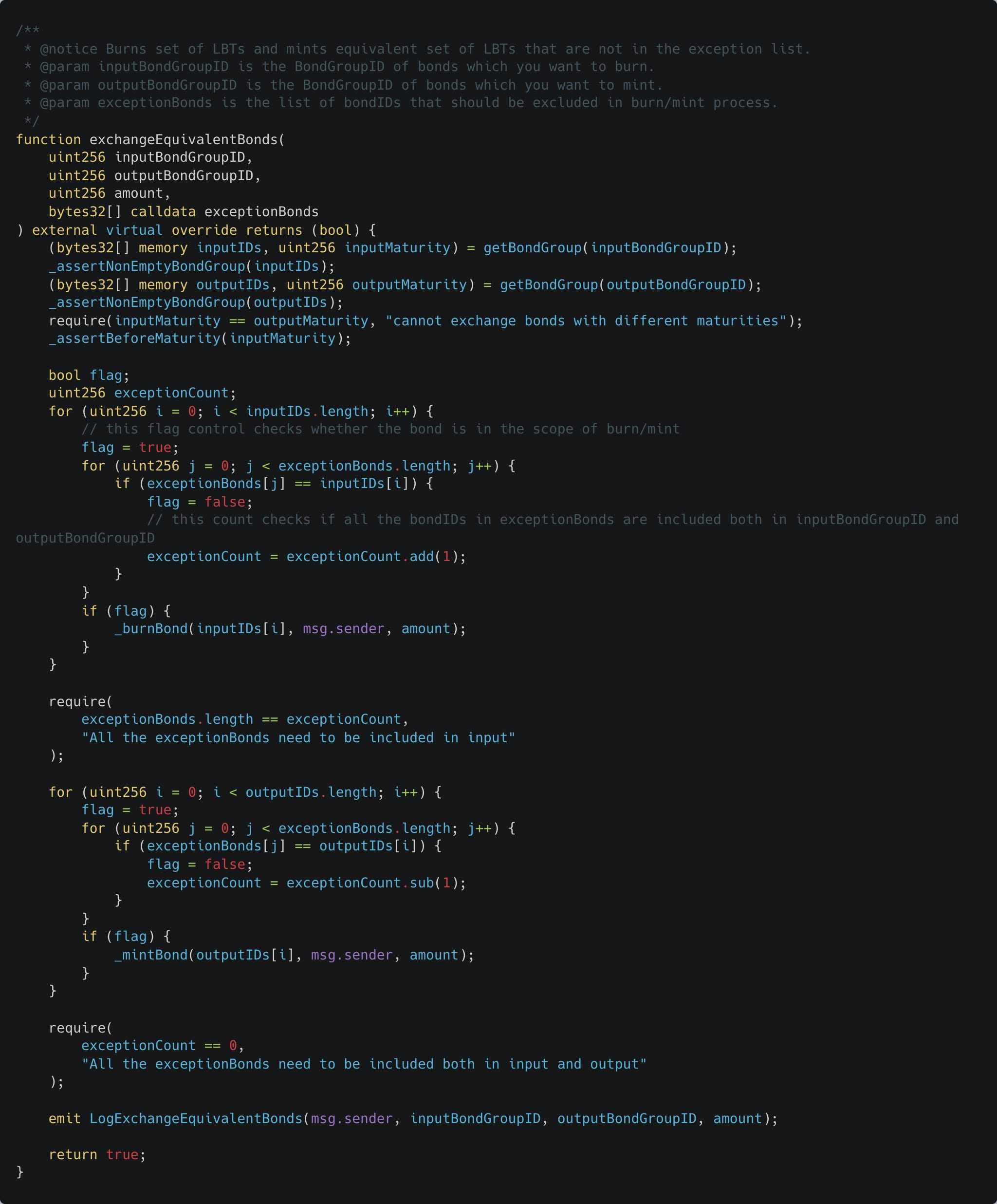
The bug is in the counter arithmetic: exceptionCount is a single running total, incremented once per match found while scanning inputIDs and decremented once per match found while scanning outputIDs. The two require statements only assert that the net count balances out to zero - they never assert that each individual bondID in exceptionBonds was matched exactly once against a distinct input bond and once against a distinct output bond. By crafting exceptionBonds and the output bond group so that the same exception bondID is matched repeatedly, the attacker could satisfy exceptionCount == 0 while a bond that should have been required in outputIDs (and thus minted only in exchange for burning something of equal value) never got the burn-side counterpart it needed - allowing _mintBond to run for bonds that were never fully backed by an equivalent burn.
The following is the verified source of _calcRateBondToErc20 as deployed at 0x656e5e976d523a427f05B0c212A22A89ccD9eF18 (GeneralizedDotc.sol):
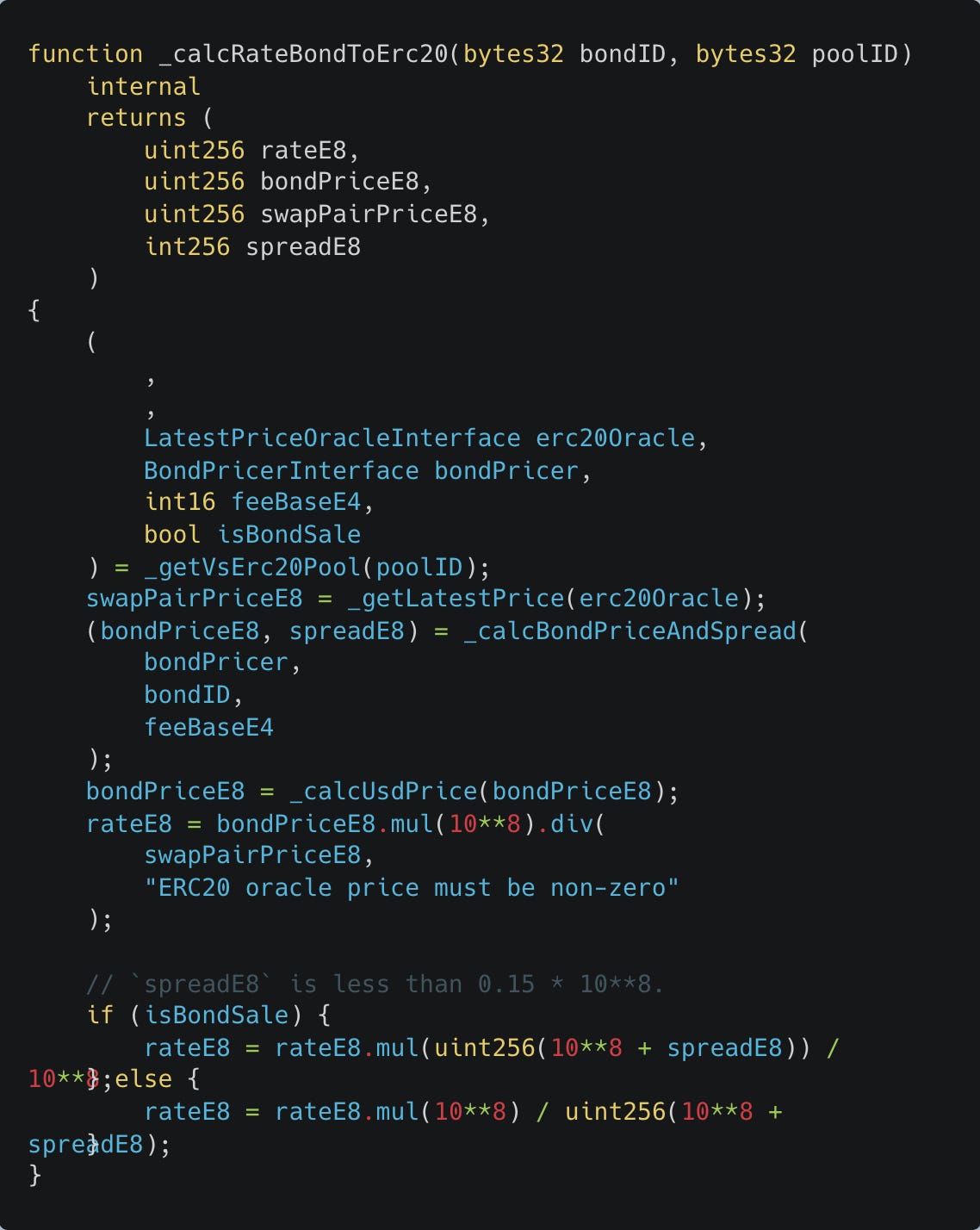
Note that bondPriceE8 comes entirely from bondPricer - a contract that prices a bond purely from its registered payoff function (fnMap) and the oracle price of the underlying, with no reference to whether the specific bond supply being priced was ever actually backed by matching collateral in the vault. Since the attacker’s bond group was permissionlessly registered with a custom payoff function, _calcBondPriceAndSpread priced it as if it were a normal, fully-collateralized bond - there was no check cross-referencing the bond’s real backing before this rate was used to swap it for USDC.
Finally, the attacker’s own orchestration contract, 0xe74d17c1bE3721E65e0af286D47B3BA58B08062e, has no verified source on Etherscan - unsurprising, since exploit contracts are essentially never voluntarily verified by their deployer. Its exact logic can still be recovered from its bytecode with a decompiler, cross-referenced against the exploit transaction’s execution trace and token-transfer logs, if a lower-level confirmation of its behavior is needed.
Conclusion
At its core, this incident was not a reentrancy bug or an access-control bypass, but a quiet logic flaw: a validation check that summed up totals instead of verifying each element individually, sitting next to a pricing function that trusted a permissionlessly-registered input without ever confirming it was backed by real collateral - together, this let the attacker mint synthetic bonds out of thin air and sell them into the protocol’s own liquidity for genuine USDC. It is a good example of how small mistakes in custom smart contract logic - especially around equivalence checks, token minting/burning, or pricing functions that consume permissionless input - can result in severe financial damage, even when the code has no obvious memory-safety or access-control issue. Protocols implementing non-standard mechanics like bond issuance, custom AMM pricing, or permissionless registration of financial instruments should treat this logic as no less security-critical than access control, and invest in comprehensive smart contract audits and security reviews - with adversarial, edge-case testing of validation and pricing logic in particular - before deploying such systems into production.